
A devotional dawn hymn to Lord Venkateswara, immortalized by the voice of M. S. Subbulakshmi.
What is Sri Venkatesa Suprabhatham?
Sri Venkatesa Suprabhatham is a Sanskrit dawn hymn traditionally recited to awaken Lord Venkateswara at the Tirumala temple in Andhra Pradesh, India. The word “Suprabhatham” literally means “auspicious morning,” and the verses are meant to gently invite the deity to begin the day, accompanied by devotion and reverence.
The hymn opens with a verse adapted from the Bala Kanda of Valmiki’s Ramayana, where Sage Vishwamitra awakens Lord Rama. From that literary and spiritual root, the text evolved into a structured sequence of verses dedicated specifically to Lord Venkateswara.
Text and Structure
The Suprabhatham as commonly recited today is part of a larger four-part composition attributed to the 15th-century poet-scholar Prativadi Bhayankaram Annan. Together, these form a complete devotional cycle:
- Suprabhatham – 29 verses of awakening and invocation.
- Stotram – 11 verses of praise and glorification.
- Prapatti – 16 verses expressing surrender at the feet of the Lord.
- Mangalasasanam – 14 verses of benediction and auspicious wishes.
For centuries, these verses were primarily recited within the temple precincts during the early-morning Suprabhata Seva, forming part of the intimate daily ritual of waking the deity before the day’s worship begins.
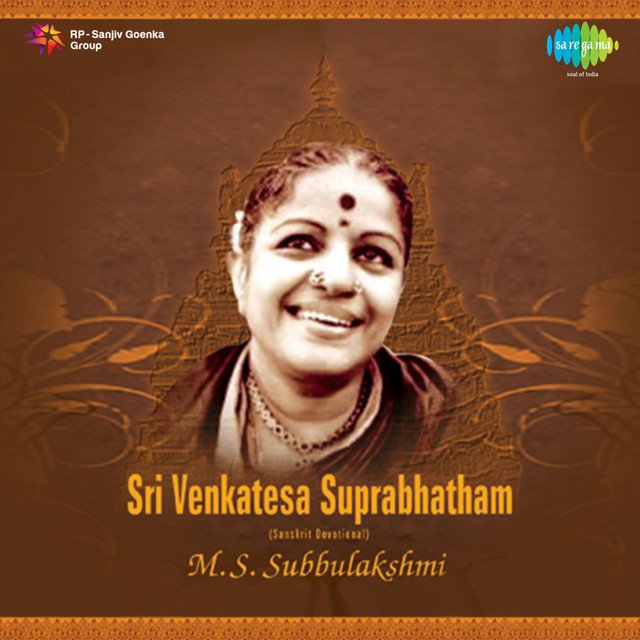
M. S. Subbulakshmi’s Iconic Rendition
M. S. Subbulakshmi, one of the most revered Carnatic vocalists of the 20th century, gave the Suprabhatham a new life beyond the temple walls. Her recording of Sri Venkatesa Suprabhatham is widely regarded as the definitive rendition and has become a daily devotional staple in countless homes.
Recording and Early Broadcasts
In the mid-20th century, encouraged by her husband T. Sadasivam, M. S. Subbulakshmi recorded the Suprabhatham for commercial release. She learned the nuances of the hymn from a temple singer deputed by the Tirumala Tirupati Devasthanam, ensuring fidelity to the traditional style and pronunciation.
The recording began to reach a wider audience through broadcasts on All India Radio (AIR), especially on auspicious days such as Vaikunta Ekadasi. These broadcasts introduced the sound of the Suprabhatham, in MS’s voice, to listeners across India.
The Landmark LP Release
In the early 1960s, the music label HMV released the LP titled “Sri Venkatesa Suprabhatham – M. S. Subbulakshmi”. The album quickly became one of the most successful devotional recordings in India, often cited as the largest-selling non-film record of its time.
Over the decades, the recording has been reissued on vinyl, cassette, CD, and digital platforms, ensuring that new generations continue to encounter the Suprabhatham through MS’s voice.
Historical Evolution
Classical and Temple Roots
The opening verse’s connection to the Ramayana anchors the Suprabhatham in the broader classical Sanskrit tradition. Prativadi Bhayankaram Annan’s 15th-century composition expanded this into a full set of verses dedicated to Lord Venkateswara, aligning with the devotional currents of the time and the growing prominence of the Tirumala temple.
For many centuries, the hymn remained primarily a temple ritual, recited by priests and temple singers during the pre-dawn worship. It was not widely available in written or recorded form to the general public.
20th-Century Popularization
The advent of radio and recorded music in the 20th century transformed how devotional texts were experienced. Visionaries in the recording industry recognized the potential of bringing the Suprabhatham to a wider audience, and M. S. Subbulakshmi’s stature and devotional depth made her the ideal voice for this effort.
Once her rendition began to circulate, the Suprabhatham moved from being a temple-only ritual to a pan-Indian devotional practice. It became common for families to play the recording at dawn, effectively turning MS’s voice into a sonic symbol of an auspicious start to the day.
Cultural and Spiritual Impact
Today, Sri Venkatesa Suprabhatham as sung by M. S. Subbulakshmi is heard in homes, temples, shops, and community gatherings across India and the global Indian diaspora. For many listeners, the combination of the sacred text and MS’s serene, devotional voice creates a sense of calm, faith, and continuity with tradition.
The recording is often described as a kind of “Hindu morning anthem,” transcending regional and linguistic boundaries. Even those who may not understand every Sanskrit word often feel a deep emotional and spiritual connection to the sound and mood of the Suprabhatham.
Key Facts at a Glance
| Aspect | Details |
|---|---|
| Primary Composer | Prativadi Bhayankaram Annan (15th century) |
| Text Components | Suprabhatham (29), Stotram (11), Prapatti (16), Mangalasasanam (14) |
| Opening Verse Source | Bala Kanda, Valmiki Ramayana |
| Traditional Setting | Pre-dawn Suprabhata Seva at Tirumala temple |
| Iconic Recording | M. S. Subbulakshmi, released by HMV in the early 1960s |
| Devotional Role | Widely used as a daily morning prayer and symbol of auspicious beginnings |
© Devotional Notes – Sri Venkatesa Suprabhatham & M. S. Subbulakshmi