
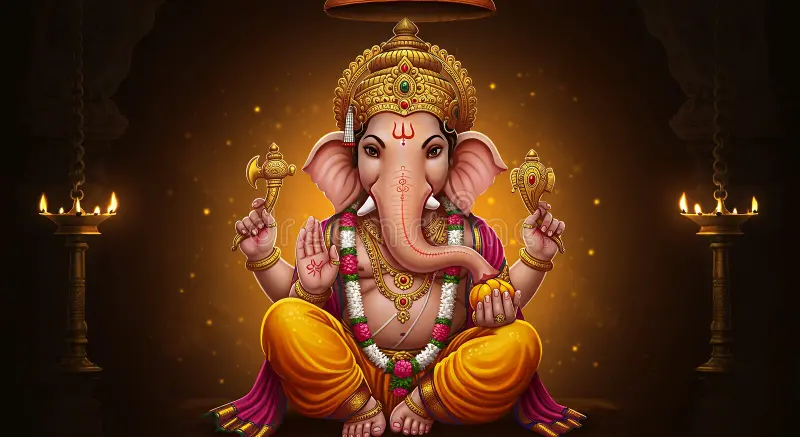
"Sankata Nasana" means "the destruction of distress." "Ganapati Stotram" means "a hymn in praise of Ganapati" — the elephant-headed deity invoked at the start of any new venture in Hindu tradition. Together, the Sankata Nasana Ganapati Stotram is a short prayer (typically eight verses, sometimes counted as twelve) that asks Ganesha to remove the obstacles standing between the reciter and a successful outcome.
Why it's recited before new beginnings
In the Hindu devotional framework, Ganesha is the Vighnaharta — the remover of obstacles. He is invoked first in almost any ritual sequence, not because he is the highest deity but because clearing obstacles is logically the first step in any other prayer or undertaking. Reciting the Sankata Nasana Stotram before exams, business meetings, weddings, journeys, or the start of any creative project is a way of asking that the path ahead be made clear.
The structure of the verses
The stotram names Ganesha by twelve of his most common names, each verse calling out one name and one of his attributes. The naming has practical devotional logic: by reciting the names, the devotee is brought into closer contact with the qualities each name represents — wisdom, persistence, protection, patience, clarity. The chant is short enough to memorise easily and can be completed in under three minutes at a comfortable pace.
How it is traditionally recited
The stotram is traditionally recited at sunrise, after bathing, facing east. Many families recite it before the morning meal. Others recite it at the start of a working day or before any major decision. There is no fixed requirement — the form is forgiving, and what matters in the tradition is the sincerity of the recitation rather than perfect Sanskrit pronunciation. Modern audio renditions in Telugu, Hindi, and Sanskrit are widely available; reciting along with a recording is an accepted practice for those still learning the words.
For first-time reciters
If you've never recited the Sankata Nasana Ganapati Stotram before, start with a daily recitation for a single Vinayaka Chaturthi cycle — the four lunar days when Ganesha is most directly worshipped. Many practitioners report that the rhythm of daily recitation, more than any single utterance, is what carries the prayer's intended effect. The tradition asks for steadiness over intensity, and it rewards that steadiness over time.